

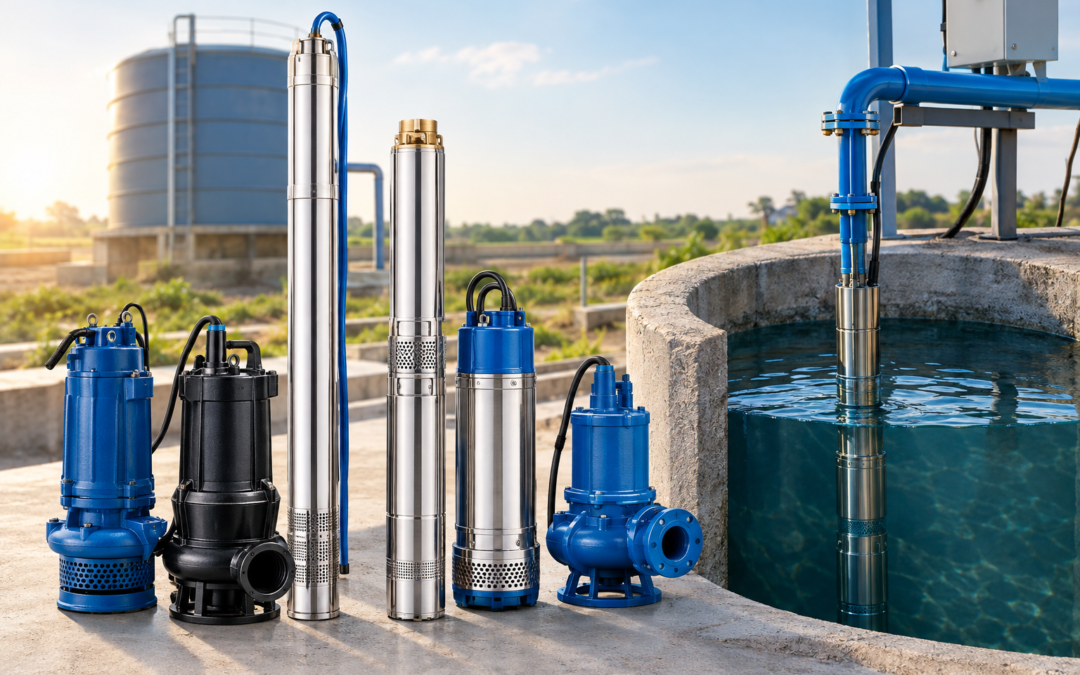
Submersible pumps move water out of wells and tanks, clear standing water, and handle irrigation and industrial drainage jobs. But picking the right water pump is more than a matter of motor power or price tag. Source depth, flow rate, total head, and the fluid itself all shape how well a pump performs and how long it lasts.
A pump built to draw water from a deep well needs something entirely different from one meant to empty a tank or clear standing water on a construction site. Before buying or installing anything, it pays to understand what separates the types and what the pump is actually made of.
How a Submersible Pump Works
A submersible pump sits inside the water or fluid it’s meant to move. Once the motor runs, the pump unit pushes that fluid out through the discharge line to wherever it needs to go.
The internal design shifts with the job: some units are built for clean water, others for drainage or fluids carrying debris and solids. Their real advantage shows up where a surface pump simply doesn’t work; deep wells and low-lying collection points are the clearest examples. But being submersible doesn’t make a pump universal. Every model comes with operating conditions that have to be respected.
Submersible Pump Types
Choosing the right submersible pump depends as much on the pumping mechanism as on where it’s going to be used. Pro Engineer works across several types:
- Multistage pumps run water through several pumping stages inside one unit, and each stage adds to the total lift. That stacked design is what makes multistage the default pick for deep wells that need serious head.
- Trash pumps are built for fluid loaded with debris or solids — construction site drainage, low-lying flood water, and similar industrial cleanup jobs.
- Hydraulic gear pumps move fluid by rotating a pair of meshing gears inside the housing, pushing it through the gaps between the gears and the housing wall. They’re suited specifically to oils and viscous fluids in hydraulic and industrial systems.
- Mono pumps use a helical rotor turning inside a rubber stator, which lets them handle viscous or solids-heavy fluids without wearing down the internals.
- Diaphragm pumps displace fluid with a flexible diaphragm instead of an impeller or rotor the right fit when dosing accuracy matters, or when the fluid is a sensitive chemical.
What the Pump Is Made Of?
The type alone doesn’t determine quality. The materials behind it matter just as much:
- Shafts are made from stainless steel grades 304, 316, 420, or 430, chosen based on the fluid and how corrosive the environment is. Grade 316 holds up better than 304 in tougher, more corrosive conditions.
- Bearings keep the shaft running true and balanced under load.
- Bushings absorb friction wear and keep the moving parts running smoothly.
- Accessories cables, strainers, carbon seals all factor into how long the pump actually lasts.
Where Submersible Pumps Get Used
- Wells: lifting groundwater to tanks or distribution networks.
- Irrigation: moving water from wells or tanks into irrigation systems.
- Tanks: filling or draining as needed.
- Drainage: clearing standing water from low-lying areas or construction sites.
- Sewage: transferring wastewater with pumps built for that job.
- Boiler feed water treatment: moving water through industrial boiler feed systems.
- Other industrial applications: any fluid transfer job that needs a fully submerged pump.
Deep Well Pumps vs. General Submersible Pumps
A deep well submersible pump is a specialized subtype built to pump water from deep wells. It’s lowered into the well itself and pushes water up to the surface or a higher point in the system. Choosing one depends on the well’s depth and diameter, water level during operation, required flow rate, and the height the water needs to reach.
Every deep well pump is submersible, but not every submersible pump is built for a well. A general submersible pump might sit in a tank or handle drainage; a deep well pump is engineered specifically for what happens inside a borehole. The difference goes beyond depth; pump design, diameter, installation method, and whether the unit can actually hit the required flow and head all separate the two. If the job is a deep well, the right call is a purpose-built deep well pump, not whatever submersible happens to be on hand.
How to Choose the Right Pump
Selection starts with what the system needs, not motor horsepower. The factors that matter:
- Flow rate: how much water needs to move in a given time. Match the pump to that number under real operating conditions, not the best-case figures on a spec sheet.
- Total dynamic head: the elevation the water has to reach, plus friction losses through pipes and fittings, plus the pressure needed at the point of use.
- For well applications, you need to know both well depth and water level, and the pump diameter must match the well diameter.
- Fluid type and temperature: clean water, solids-laden water, sewage, and industrial fluids all call for different pump builds, and temperature affects which materials hold up, especially in something like boiler feed applications.
- Motor power has to match flow and head requirements. More horsepower doesn’t automatically mean better performance if it’s out of step with everything else.
- Pipe diameter affects friction loss, flow rate, and available pressure, which is why the pump and piping should be chosen as one system.
- Operating conditions continuous or intermittent, frequent cycling, or site-specific stress all of it shapes which pump fits.
Pro Engineer’s Submersible Pump Solutions
Getting the pump right starts with understanding the application and working out the actual requirements, then matching those against pump specs and materials. Pro Engineer covers design, supply, installation, and maintenance for submersible deep well pumps across all types multistage, trash, gear, mono, and diaphragm with the stainless steel grade selected to fit the application and hold up against corrosion.
Contact Pro Engineer for the right submersible pump for your project.